Introduction: The Allure of “Free” Terminal Offers
For businesses shopping for payment processing solutions, the offer of a “free” card terminal can be extremely tempting. This appealing proposition appears to eliminate upfront hardware costs while providing essential payment acceptance capabilities. However, conducting a thorough card payment comparison calculator analysis reveals that these “free” offers often come with significant hidden costs that can dramatically exceed the actual value of the terminal hardware. According to the Competition and Consumer Protection Commission, approximately 62% of Irish merchants report unexpected costs associated with “free” terminal agreements, with the average business paying an additional €1,200-2,600 over their contract term. At Compayre.ie, we’ve analyzed the complete economics of terminal acquisition models to help businesses understand the true cost of ownership and make informed decisions when selecting payment hardware.
Using a Card Payment Comparison Calculator to Evaluate Terminal Options
Common Terminal Provision Approaches
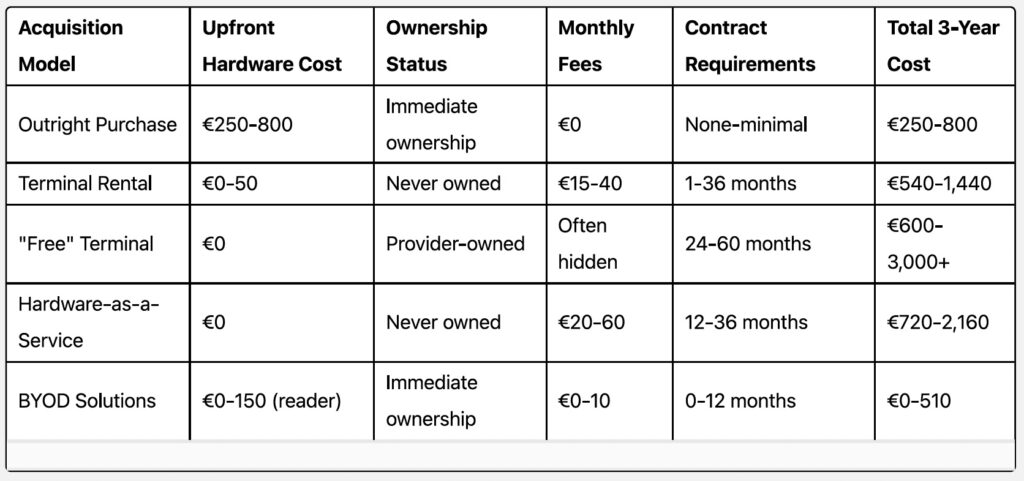
Before diving into our detailed terminal hardware comparison, let’s clarify the typical acquisition models available:
Terminal Acquisition Options Comparison
Key Acquisition Distinctions
- Capital vs. operational expense: Accounting treatment differences
- Ownership rights: Ability to reprogram or resell
- Upgrade flexibility: Technology refresh options
- Maintenance responsibility: Repair and replacement obligations
- Exit implications: Terminal return or buyout requirements
According to the Small Firms Association, approximately 70% of small businesses select “free” terminal offers despite the higher total cost, primarily due to cash flow considerations and lack of awareness about the full economic implications.
Card Payment Comparison Calculator: Hidden Costs Behind “Free” Terminals
Contract Length Requirements
The most significant hidden cost factor in “free” terminal deals:
Contract Duration Analysis
- Typical minimum commitment: 24-48 months (vs. 0-12 for purchased)
- Auto-renewal clauses: Additional 12-24 months if not canceled
- Cancellation windows: Often limited to 30-90 day periods
- Multiple terminal implications: Each device with separate contract
- Terminal age considerations: Older hardware with same commitment
A thorough card payment comparison calculator assessment reveals that “free” terminal contracts typically require commitments 2-4× longer than other acquisition methods, creating significant flexibility limitations.
Card Payment Comparison Calculator: Processing Rate Analysis
“Free” terminals are typically subsidized through higher transaction costs:
Rate Difference Examples
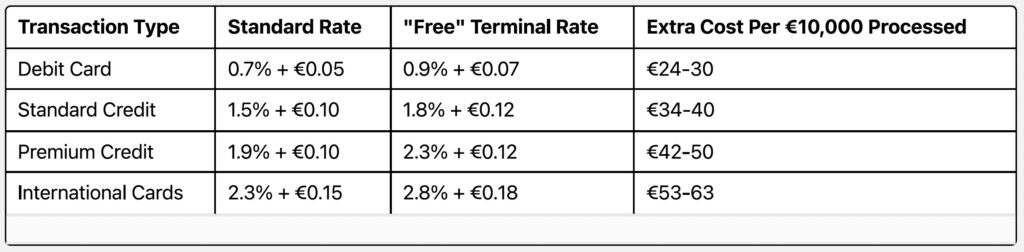
Our terminal hardware comparison research indicates these rate premiums typically recover the terminal cost within 6-9 months while continuing throughout the entire contract term.
Monthly Fee Structures
Additional recurring charges frequently accompany “free” hardware:
Common Monthly Fees
- Terminal maintenance fee: €5-15 monthly
- PCI compliance charge: €5-20 monthly
- Gateway or technology fee: €10-25 monthly
- Minimum processing requirement: €20-50 if not met
- Statement or reporting fee: €5-15 monthly
According to data compiled using our card payment comparison calculator, these monthly fees can add €300-900 annually to the cost of a “terminal” that might retail for €300-500 if purchased outright.
Use our terminal cost calculator to estimate the true cost of “free” terminals based on your specific processing patterns.
Card Payment Comparison Calculator for Exit Costs and Penalties
Contract Cancellation Economics
Early exit from “free” terminal agreements can trigger substantial penalties:
Common Termination Fee Structures
- Flat cancellation fee: €250-800 per terminal
- Liquidated damages formula: Monthly fees × remaining months
- Terminal buyout requirement: €200-600 per device
- De-installation charges: €50-150 per location
- Return shipping requirements: €30-80 per terminal
The European Payments Council notes that approximately 30% of merchants attempt to exit terminal contracts early, with early termination fees averaging €650 per terminal.
Real Exit Cost Scenarios
Let’s examine typical termination situations:
Scenario 1: Business Sale/Closure
- Remaining contract: 18 months on 36-month agreement
- Standard termination fee: €300-500 flat fee
- Terminal buyout option: €250-400
- Processing agreement penalties: €15-35 × 18 months
- Total exit cost range: €700-1,500 per terminal
Scenario 2: Provider Switch
- Remaining contract: 30 months on 48-month agreement
- Standard termination fee: €400-800 flat fee
- Terminal return requirements: Specific packaging and shipping
- Processing agreement penalties: €15-35 × 30 months
- Total exit cost range: €850-1,850 per terminal
Our terminal hardware comparison reveals that exit costs can easily exceed the original retail value of the terminal by 2-4× if terminated in the first half of the contract.
Visit our contract review guide for assistance identifying potentially problematic terminal agreement terms before signing.
Technology Refreshes and Upgrade Limitations
Hardware Lifecycle Considerations
“Free” terminals often involve technology limitations:
Upgrade Restriction Issues
- Terminal age at provision: Often not newest models
- Technology advancement timing: Payment innovations during contract
- Upgrade expense allocation: Costs for newer features
- Contract reset with upgrades: Commitment extensions with new hardware
- End-of-life support concerns: Obsolescence during contract
According to our terminal hardware comparison analysis, “free” terminals are typically 1-2 years into their lifecycle when provided, meaning they may become technologically outdated before the contract concludes.
Security and Compliance Implications
Older terminals can create security and regulatory challenges:
Security Limitation Concerns
- PCI compliance requirements: Changing security standards
- Encryption protocol updates: Evolving protection measures
- Contactless limit adjustments: Hardware capability constraints
- Authentication method evolution: Newer verification approaches
- Vulnerability management: Security patch availability
The Central Bank of Ireland recommends terminal replacement every 3-4 years to maintain optimal security standards, which often conflicts with longer “free” terminal contract durations.
Card Payment Comparison Calculator: Alternative Acquisition Models
Outright Terminal Purchase Benefits
Buying hardware directly offers several advantages:
Purchase Model Advantages
- No processing rate premium: Free to negotiate best transaction fees
- No contractual commitment: Freedom to switch providers
- Complete ownership control: Ability to reprogram or resell
- One-time expense: No ongoing hardware charges
- Provider flexibility: Can use with multiple processors
Our card payment comparison calculator data shows that businesses processing over €5,000 monthly typically recover the purchase price through better processing rates within 7-12 months compared to “free” terminal options.
Terminal-as-a-Service Models
Newer rental models provide greater flexibility:
Modern Rental Advantages
- Regular technology refreshes: Staying current with innovation
- Maintenance inclusion: Repair and replacement coverage
- Shorter commitments: 12-24 month options common
- Bundle pricing transparency: Clear monthly cost visibility
- Scaling flexibility: Easy addition or reduction of terminals
According to the Retail Excellence Ireland, businesses with multiple terminals or frequent technology needs often find rental models more cost-effective than either purchasing or “free” agreements.
Mobile/BYOD Solutions
Smartphone-based options eliminate traditional terminal needs:
Mobile Solution Benefits
- Hardware cost reduction: Uses existing smartphones/tablets
- Minimal commitment requirements: Often month-to-month
- Regular technology updates: App-based feature improvements
- Multiple device capability: Not tied to specific hardware
- Location flexibility: Payment acceptance anywhere
Our terminal hardware comparison shows mobile solutions can reduce hardware costs by 60-90% compared to traditional terminals while offering greater flexibility for businesses with variable or mobile payment needs.
Explore our mobile solution comparison to evaluate if smartphone-based options might meet your payment acceptance needs.
Creating Your Own Card Payment Comparison Calculator
Card Payment Comparison Calculator: TCO Analysis Method
Follow this framework for accurate cost comparison:
Complete TCO Analysis Components
- Hardware acquisition costs: Purchase price or rental value
- Transaction fee differentials: Rate premium calculations
- Monthly fixed charges: All recurring fees
- Contract commitment value: Flexibility limitation cost
- Technology refresh requirements: Upgrade needs and timing
- Exit scenario planning: Potential termination expenses
TCO Comparison Example
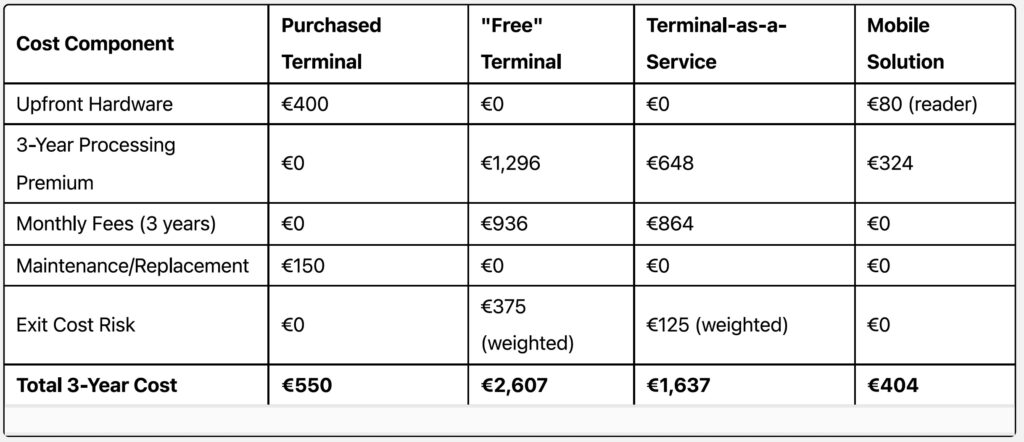
Based on €10,000 monthly processing with typical transaction mix
This card payment comparison calculator example demonstrates how “free” terminals often represent the highest total cost option despite eliminating upfront expenses.
Business-Specific Considerations
Various factors influence the optimal acquisition approach:
Key Decision Factors
- Cash flow constraints: Available upfront capital
- Processing volume stability: Transaction consistency
- Business longevity expectations: Operational timeline
- Technology requirements: Feature needs and innovation pace
- Hardware quantity needs: Single vs. multiple terminal operations
Our terminal acquisition decision tool can help identify the optimal approach based on your specific business requirements.
Case Studies: Terminal Acquisition Decisions
Retail Business Terminal Selection
A boutique clothing retailer evaluated terminal options:
Situation: Single store needing two terminals with €8,000 monthly processing
Options Considered:
- “Free” terminals with 48-month contract
- Purchase terminals outright for €375 each
- Terminal-as-a-Service for €25 monthly each
- Mobile readers with existing tablets for €70 each
Decision: Purchased terminals outright
Key Factors:
- Stable business with 5+ years operating history
- Sufficient capital for upfront purchase
- Significant processing rate differences between options
- No immediate need for advanced features
- Desire for long-term flexibility
Outcome: Recovered purchase cost through lower processing rates within 9 months, saved approximately €2,300 over three years compared to “free” option.
Restaurant Terminal Acquisition
A new restaurant evaluated payment hardware options:
Situation: New business with limited capital, needing three terminals and €12,000 projected monthly processing
Options Considered:
- “Free” terminals with 36-month contract
- Purchase terminals outright for €425 each
- Terminal-as-a-Service for €30 monthly each
- Mobile solutions with dedicated tablets
Decision: Terminal-as-a-Service model
Key Factors:
- Limited upfront capital availability
- Uncertain business longevity as new venture
- Desire for current technology with regular updates
- Moderate processing volume
- Multiple terminal requirement
Outcome: Balanced moderate monthly costs with flexibility, while avoiding long-term commitment and higher processing rates of “free” option, projected savings of €1,800 over three years.
Making Your Terminal Acquisition Decision
Decision Framework for Businesses
Follow this structured approach to terminal selection:
Terminal Acquisition Decision Process
- Calculate processing volume and patterns: Monthly transaction totals
- Project business timeline and stability: Operational expectations
- Assess capital vs. operational expense preference: Accounting priorities
- Evaluate technology and feature requirements: Functionality needs
- Analyze contract flexibility importance: Switching probability
- Compare complete three-year ownership costs: Total expense projection
Common Scenario Recommendations
- Established stable business: Terminal purchase often optimal
- New/uncertain venture: Terminal-as-a-Service frequently best
- Mobile/variable operation: Smartphone-based solutions typically ideal
- Multi-location enterprise: Mixed approach sometimes most effective
- Seasonal business: Mobile or short-term rental generally preferable
Our terminal hardware comparison research shows that the best acquisition method varies significantly based on business-specific factors rather than following a one-size-fits-all approach.
Negotiation Strategies for Better Terminal Terms
Improving “Free” Terminal Offers
If cash flow requires a no-upfront-cost option, negotiate these improvements:
Key Negotiation Targets
- Shorter contract duration: 24 vs. 36-48 months
- Elimination of auto-renewal: Require explicit renewal authorization
- Reduced early termination fees: Capped penalties or declining schedule
- Processing rate concessions: Minimize or eliminate rate premiums
- Monthly fee waivers: Remove maintenance or PCI charges
- Technology refresh guarantees: Scheduled hardware updates
The Small Firms Association reports that approximately 60% of merchants successfully negotiate improved terminal terms when specifically addressing these factors before signing.
Leverage Points for Better Terms
Several factors can improve your negotiating position:
Negotiation Advantage Factors
- Processing volume documentation: Higher volumes increase leverage
- Competitive offers: Alternative proposals strengthen position
- Business stability evidence: Operational history builds confidence
- Multi-service bundling: Additional product adoption creates value
- Industry peer benchmarking: Comparison data supports requests
Our negotiation guide provides specific strategies for securing better terminal terms based on your business profile.
Conclusion: Beyond the “Free” Terminal Marketing
When evaluating payment hardware options, looking beyond the initial acquisition cost to understand the complete total cost of ownership is essential for making informed decisions. Our comprehensive card payment comparison calculator research demonstrates that “free” terminal offers typically represent the highest total cost option over a three-year period, despite eliminating upfront expenses.
Rather than focusing exclusively on avoiding initial hardware costs, we recommend conducting a thorough terminal hardware comparison that evaluates transaction fees, monthly charges, contract commitments, exit costs, and technology requirements. The optimal acquisition approach often isn’t the “free” option but rather the model offering the best balance of upfront affordability, long-term value, and operational flexibility for your specific business needs.
At Compayre.ie, we help Irish businesses navigate these complex terminal decisions with vendor-neutral comparisons and personalized recommendations based on your specific processing patterns and business requirements.
Frequently Asked Questions
How much does a card terminal actually cost the provider?
Terminal wholesale costs to providers typically range from €150-350 for standard models, with premium or specialized terminals reaching €400-600. This creates a significant disconnect with retail prices (€300-800) and especially with the implied costs in “free” terminal agreements (often €1,200-2,500 over the contract). The substantial markup in “free” agreements comes from combination of hardware markup, processing rate premiums, monthly fees, and contract commitment values. Providers can offer terminals “free” because they recover 2-4× the hardware cost through these other charges over the contract term.
Can I negotiate out of a long-term commitment for a “free” terminal?
Yes, though with limitations. Approximately 30-40% of merchants successfully negotiate reduced commitment periods (24 vs. 36-48 months) or capped early termination fees when specifically addressing these terms before signing. The most effective approach combines processing volume leverage (higher volumes increase negotiating power) with competitive offers from other providers. However, providers rarely eliminate commitments entirely for “free” hardware due to their cost recovery model. If commitment-free terms are essential, terminal purchase or month-to-month mobile solutions typically represent better options.
What happens to my terminal if I close my business before the contract ends?
In most “free” terminal agreements, you’ll face several potential costs: (1) Early termination fees ranging from €250-800 per terminal or calculated as remaining monthly minimums, (2) Terminal buyout requirements if you wish to keep the hardware (€200-600), or (3) Terminal return obligations requiring specific packaging, shipping methods, and condition standards. Many agreements also include de-installation fees for terminal removal. These combined costs can easily reach €500-1,500 per terminal, which often exceeds the terminal’s actual value. This creates a significant financial consideration for businesses with uncertain longevity.
Are there any situations where a “free” terminal is actually the best option?
Yes, in specific circumstances: (1) Extremely cash-constrained businesses unable to afford any upfront costs, (2) Very short-term operations planning to pay early termination fees, (3) Low-volume processors where transaction fee differences have minimal impact, or (4) Businesses specifically needing the terminal model offered without capital expense. However, these situations represent the minority of cases—our terminal hardware comparison data indicates that for approximately 70-80% of established businesses processing over €5,000 monthly, purchase or Terminal-as-a-Service models typically provide better long-term value than “free” options.
How do mobile payment solutions compare to traditional terminals for small businesses?
For many small businesses, mobile solutions offer compelling advantages: (1) Significantly lower hardware costs (€50-150 for readers vs. €300-800 for terminals), (2) Minimal or no contractual commitments, (3) Regular software updates through apps, (4) Flexibility to use multiple devices, and (5) Location independence for mobile operations. The primary limitations include higher transaction rates (usually 0.2-0.5% above traditional processing), potential reliability/connectivity challenges, and more limited support for certain payment types. Our card payment comparison calculator analysis shows mobile solutions typically provide the lowest total cost option for businesses processing under €5,000 monthly or requiring location flexibility.
Need personalized guidance evaluating terminal acquisition options? Contact Compayre.ie at +353 1 265 4403 for expert advice tailored to your specific business requirements. As a Guaranteed Irish company, we provide unbiased, vendor-neutral comparisons to help you find the most cost-effective payment hardware solution for your business.
*[PCI]: Payment Card Industry *[BYOD]: Bring Your Own Device *[TCO]: Total Cost of Ownership